Hindsight

Speaking of the cold… Can you figure out this rebus word puzzle?

Rebus CHILL

If you got that one, can you get this one? You’re getting warmer!

Rebus SPRING

Over the past few weeks, the girls and I have been working hard to solve a collection of rebus puzzles.

Some of them are so obvious, you can’t not see the answer right away. The letter “P” with an arrow pointing up above it? That’s “Pup,” of course.

Some of them require a little out-of-the-box thinking. The letter “S” with a rabbit next to it? Srabbit? Sbunny? What’s another word for ‘rabbit’? Oh! It’s “Share”!

Others you feel like you could stare at for hours and never figure them out. The letter “G” with a circle underneath it? “Go?” Nope, that’s not it. Oh – how about “Ground?” Nope. It took weeks, but we finally got it – “Underground”. Get it? The “round” is “under” the “G”. 🤦

Every time we open up a new ‘level’ in this app, we flip through the puzzles and do our best to solve them. Some we get on first glance, some take a little collaborative thinking, and some leave us saying, “We’re never going to get that one!”

But, guess what? We always do – and then say to each other, “How did we not see that?”. Once you’ve “seen” the answer, not only can you not unsee it – you can’t imagine how you ever didn’t see it in the first place!

Hindsight is 20/20. Unfortunately, foresight – or even in-the-moment sight isn’t! Hard situations and crisis moments can leave us feeling puzzled and unsure of what to do. There are so many times I wish God would just hand me a list of “Instructions on How Mandy Desilets Should Handle This Exact Situation”. (Wouldn’t that be great?) He’s promised to guide me and I’m looking to Him for help, but sometimes I feel like I’m staring at the picture thinking, “I can’t do this!”

In Psalm 25, David sings about the ways God guides us:

Show me your ways, Lord,
   teach me your paths.
Guide me in your truth and teach me,
   for you are God my Savior,
   and my hope is in you all day long…
Good and upright is the Lord;
   therefore he instructs sinners in his ways.
He guides the humble in what is right
   and teaches them his way.
(Psalm 25:4-5, 8-9)

Because our God is “good and upright”, He doesn’t just keep all that goodness and uprightness to Himself – He is always actively leading us, as His children, toward goodness and uprightness. He does this by revealing His own ways to us and instructing us in how we, as humans, can act in those ways as well. As our Guide walks in front of us, so can we put our feet where His feet were and walk in the direction He points.

Life would be a whole lot easier if I always walked in His ways, but as much as I want all that goodness and uprightness to characterize my life, the forces of fear, judgment, and pride tend to speak just as loud (if not louder) and I end up letting them guide me instead. Although I wish I never had any failures, every time I handle a situation poorly I can look back, see clearly what I should have done, and let it become something my faithful Guide can use to show me the right path.

When we look at our rebus puzzles now, after completing several levels, we have a strategy:

  1. Details. Though not every detail of the picture is significant, you have to break it down into parts. Does that little stem off the top of that pod of peas resemble a letter? Yep! That’s an “R” which means the answer is “Pear”!
  2. Position. Short words like on, in, of, or, and, etc… find themselves inside lots of other bigger words. An “ant” “on” an “F”? Or is the “ant” “in” the “F”?
  3. Synonyms. Sometimes the word is just is what it is, but sometimes it’s not. That’s an “L” floating in water. Is that water “liquid”? Some “waves”? A “lake”? The “ocean”? A “sea”?
  4. Big Picture. It’s easy to get caught up in the details and end up trying too hard. It’s a picture of an upside-down hanger. Is there a letter in that? A number? A shape? What’s another word for “hanger”? Oh! 😂 It’s a “bat” – an “upside-down hanger”!

Every time I’m facing an “I don’t know what to do! I can’t handle this!” situation and I’m looking to my Guide for help, there’s a good chance the Holy Spirit’s going to point backwards – not to shame me for my mistakes, but so He can use the hindsight I now have from a previous situation to guide me in this one.

  1. Details. Does this situation resemble another that I’ve faced? It may not be exactly the same, but there’s a good chance I have been here before.
  2. Position. When I faced this situation previously, where was my heart in relation to God’s? Was I laying it open in trust? Or was it closed up in fear and doubt?
  3. Synonyms. What were my options for action/reaction? How many of them were based on fear, judgment, or pride? What did I choose and how did it work out for me?
  4. Big Picture. Was I overthinking then? Am I overthinking now? Do I need to step back and think about the obvious, general commands and ways of God?

The first verse of Psalm 25 is: “In you, Lord my God, I put my trust.” Trust doesn’t come naturally – it’s built over time and every opportunity that’s placed in front of me is a stepping stone. I might not know exactly what to do, but letting the Holy Spirit use that 20/20 hindsight view will give me some clues!

If you get that, can you get this one?

Rebus TRUST

Enter your email address to subscribe to this blog and receive notifications of new posts by email.

Think

A 30° day in April is worse than a 10° day in January. After basking in the glory of 75° and sunny this Saturday, we were all tricked into putting away the hats and gloves and winter coats. Make way for spring! Or so we thought…

And then Monday happened. And 30° happened.

In January I had the ability to give myself a swift kick in the pants and just get outside. For the first time in many years, I reached my winter goal of getting at least one run or hike in every week – no matter how cold it was. When Saturday’s t-shirt and flip-flops weather hit, I felt like I had crossed the finish line!

Then I looked at 30° on Monday morning, and the last thing I wanted to do was voluntarily go outside when I didn’t have to! “But it’s cold,” I thought, “and I’m so sick of the cold. I just can’t.”

But after forgetting to say “Decaf” when ordering my Americano that morning and having the feeling I might spontaneously combust if I didn’t do something active, I put my shoes on and went anyway.

And guess what? Seven minutes in and I was rolling up my sleeves thinking, “I’m roasting. I should have worn a lighter shirt!” 🤦

This is not a new lesson for me. I learn it every. single. time. I go for a run in the cold. I never want to get my running clothes on because all I can think about is how cold I’m going to be. I never want to walk out the door because all I can think about is how warm and comfortable my house is. There are many days the warm house and warm clothes win and I can’t get myself to do it!

I know the discomfort of the cold will only last for approximately seven minutes. Seven minutes is less than a mile. In seven minutes, I will forget that I was ever cold! But sometimes seven minutes feels like a long time.

20190402_193749_0001

Being a follower of Jesus and being comfortable are phrases that rarely show up in the same sentence. We like all the stuff about how much God loves us and how He’s got a plan for our lives – but this whole ‘deny yourself’ thing isn’t much fun. Deep down I know that God’s infinitely wise voice is leading me toward all the good things He has for me, but sometimes I’m not so sure I want to go that way!

In Romans 13, Paul pleads with his readers to “wake from sleep” and “put on the armor of light” (v. 11-12). He instructs them to “walk properly as in the daytime” by living life as if this “light” was shining on them, exposing their actions at all times (v. 13). And how should they do this? First, “put on the Lord Jesus Christ” and second, “make no provision for the flesh, to gratify its desires.” (v. 14)

When I ‘suit up’ for my day, ‘clothing’ myself with Christ is a great place to start. Connecting with Him and being reminded that “It is no longer I who live, but Christ who lives in me” (Galatians 2:20) snaps me out of my self-focused, comfort-driven daze. But that doesn’t mean it completely goes away! Throughout my day, it’s a guarantee that temptation will fade right back in – whether it’s an invitation to gratify my sinful nature or the thought that I’d rather turn around and go home than follow through with an opportunity God has placed in front of me.

When Paul said “make no provision” he meant to not ‘enable’ or ‘allow for’ sin and disobedience to happen.* The way we do that enabling is, as the NIV translates, by “think[ing] about” it. Of course we must “think about” our choices, but Paul is talking about the kind of thinking that plans ahead with a focus on the fulfillment of a desire. In other words, the more I think about my desires, the more I’m likely to make the choice to fulfill them.

Making “provision” happens when I engage in lengthy debate with myself over a choice. Is that really the Holy Spirit leading me or is it just my guilt speaking? I start to rationalize: “I think I can probably handle this, it’s not really that bad. I’ll just do it this way.” or “I’m just so stressed I need to do/say this right now because it will give me relief”. Or “There’s no way I can face that situation! I won’t handle it well!” and “Serving in that way will take too much of my energy and I’m just so tired…”

Lately, once I’ve decided I’m going for a run, I don’t think – I just go. I’ve learned to not, as my Grandma might say, ‘hem and haw’ over the decision. I get dressed, throw on my shoes, and run out the door before I have time to talk myself out of it!

I don’t want to be uncomfortable. And ‘denying myself’ is a fast track to uncomfortable. Obeying God when He’s leading me out of my comfort zone? I don’t think that’s going to feel good. It would be much easier to stay in my warm house, in my warm clothes, sitting in my warm chair… Yeah, that would be better. 😉

But when I do obey, does the initial discomfort last more than seven minutes? Honestly, I’m not sure it ever does. Temptation tends to lose its power, and those hard things never end up being as hard as I thought they’d be. It’s amazing how quickly I *warm up* after taking those first steps to just do it!

*https://biblehub.com/greek/4307.htm

Enter your email address to subscribe to this blog and receive notifications of new posts by email.

Loaves

As a kid there was one thing I looked forward to about church every Sunday: the end of the service. Though the little kids only had to sit through halftime, the bigger kids had to stay. Not only was I bored, but after getting there early and then sitting through Sunday school and church, I was hungry!

Unless it was a communion Sunday – because then we got food! But not really. I remember anxiously watching the ushers bring the loaves of bread around and then, following my mother’s instructions, ripping a ‘small’ piece from the loaf. ‘Small’ meaning the largest piece I could get away with, of course!

As I watched the ushers carry the almost-full loaves of bread back to the front of the sanctuary, all I could think was how unfair it was. Surely there was enough for everyone to have had more! There weren’t that many people in the room – why didn’t they just pre-cut the bread and let everyone have a whole slice?

Well, I guess it would have been hard to wash down with that tiny half-sip of grape juice, anyway. 😉

DSC_7536 YES-01

If you’ve ever had a ‘good’ quiet time with God, then you know what I mean by a ‘good’ quiet time with God. One of those times where you close your Bible or devotional and, with a deep sense of satisfaction, think “Wow! That’s so good!”. Sometimes it’s just the inspiration you need to face a challenge coming at you that day. Or a verse that brings you to your knees in awe of our great God. Or even a conviction you’ve been avoiding.

Whatever it is, feeling like you’ve heard from God in a personal way rocks. There aren’t many words to describe the sense of fulfillment it brings!

John 6 tells the story of Jesus miraculously turning five barley loaves and two fish into enough food for over five thousand people. With word of His healing abilities spreading rapidly, large crowds were before Him at every stop. And in this “desolate place” (Matthew 14:15), after many hours of watching and listening to Jesus, the people were understandably hungry.

So He fed them. And He didn’t just provide enough for each of them to have a bite – they all got “as much as they wanted” and ate “their fill”. (John 6:11-12). There were even leftovers!

After not only witnessing a miracle like this, but physically experiencing it for themselves, you can imagine the people were then hungry for more! So when they couldn’t find Jesus in that same place the next day, they followed Him to “the other side of the sea”. (v. 25)

But when they found Jesus, He said to them: “‘Truly, truly, I say to you, you are seeking me, not because you saw signs, but because you ate your fill of the loaves.’” (v. 26) Jesus could see their hearts and knew exactly how to expose them. They were there because they wanted more – not because the food was a gourmet treat or because they were desperate for some free eats – they wanted more of the “WOW!”. The physical sensation of experiencing Jesus’ miracles firsthand was a ‘meal’ worth chasing!

In verse 35 Jesus assured them He was worth chasing – but not for the reasons they had been doing so: “‘I am the bread of life. Whoever comes to me will never go hungry, and whoever believes in me will never be thirsty.’” In Himself, Jesus had something to offer that would be more fulfilling and more satisfying than anything He could do or any way He could excite their senses. And they would experience that when they believed in Him just for Him – not for what they could get out of Him.

When I open my Bible, flip to today’s page in my devotional, turn on that worship song, or close my eyes to pray, I’m aware that there are loaves upon loaves of ‘stuff’ to be ‘gotten’ from Jesus. I know that He has the power and ability to “WOW!” me by exciting my senses with His words or His presence. But am I only going to Jesus for what I can ‘get’ out of Him? Am I after my “fill” or just after Him?

No matter how I feel as I get up to move on with my day, I can be assured that Jesus’ promise in John 6:35 is real. No matter how small the portion feels, I will never leave hungry or thirsty when I come to Him!

Enter your email address to subscribe to this blog and receive notifications of new posts by email.

Label

It’s amazing how much stuff we humans accumulate. Especially when we’re kids!

Last week, after tripping over one.more.thing. while tucking the girls in at night, I decided it was room-cleaning time. Though we try to make light ‘pick-ups’ part of our routine, every now and then we need a total overhaul! And with a lost library book as extra motivation, it was time.

Picking the stuff up was the easy part. Figuring out what to do with all the stuff was the problem. Is it trash? Recycling? Donation? Are you sure you need to keep that?

As the process dragged on, it was hard not to think about how much easier it would have been to go through the room myself. As an adult, I have 40-ish years of experience with “stuff,” and as their mom, I know what should be labeled “keep” and what should be labeled “GO”. But convincing them of that was a much harder task!

DSC_7511-01

When one of our students wants to start reading the Bible, I usually suggest they start with the book of Mark. It’s short, so it’s reasonable to set as a goal and Mark’s “to the point” writing makes it easy to get a solid picture of who Jesus is.

One of the themes that’s easy to pick up on in the first two chapters is Mark’s emphasis on Jesus’ authority. Proclaiming Him from verse one as the unique and only “Son of God,” Mark then tells of Jesus receiving a sign of this authority at His baptism: “And when he came up out of the water, immediately he saw the heavens being torn open and the Spirit descending on him like a dove. And a voice came from heaven, ‘You are my beloved Son; with you I am well pleased.’” (1:10-11)

Then, without wasting any time, Mark dives right into the proof. In verse 22, he describes that those in the synagogue “were astonished at his teaching, for he taught them as one who had authority, and not as the scribes.” In verse 27, they were “all amazed” that ‘”He commands even the unclean spirits, and they obey him.”’ Verses 40-41 describe Jesus’ authority over disease and the human body: “‘If you will, you can make me clean.’… ‘I will; be clean.’” Chapter two begins with Jesus using this authority over the human body to prove His ability to forgive sin.

In our 21st century American life, the word “authority” makes us roll our eyes. We like to make our own decisions and be the judge of what’s right for us. We’re self-aware and know what we can handle, after all. We’re also experts on labeling our “sin” and deciding whether or not we can keep it.

In our “relationship with Jesus”-focused 21st century Christianity, it’s easy to forget that Jesus is not only “friend,” but also “Lord”. Yes, He loves and cares for me. Yes, He is filled with compassion and I can lean on Him for support. But I can’t forget that when I signed up to receive Him, I also received His authority into my life.

My heart is as frustrating as my kids’ room in the dark – it seems like I keep getting tripped up on one.more.thing I didn’t know was there. And the worst part is when Jesus comes in and starts telling me what to do about it! After labeling it with its real name (I’d prefer if He kept it a little more ‘politically correct’), He tells me what to do with it. Then, if I don’t do it, He keeps bugging me about it. (Recently, after several attempts, He got me to get rid of my ‘guilty pleasure’ TV show – He can be a real stinker sometimes!)

There are days when I wonder why He doesn’t just get it over with and clean me up, already. Surely with all that authority and experience, He could just snap His fingers and with a ‘spoonful of sugar,’ make it all go away.

But as a good parent, Jesus knows the process is more important. He knows “relationship” happens when I make the choice to acknowledge His authority by agreeing with Him about my sin and then obeying His instructions about it!

Enter your email address to subscribe to this blog and receive notifications of new posts by email.

Reins

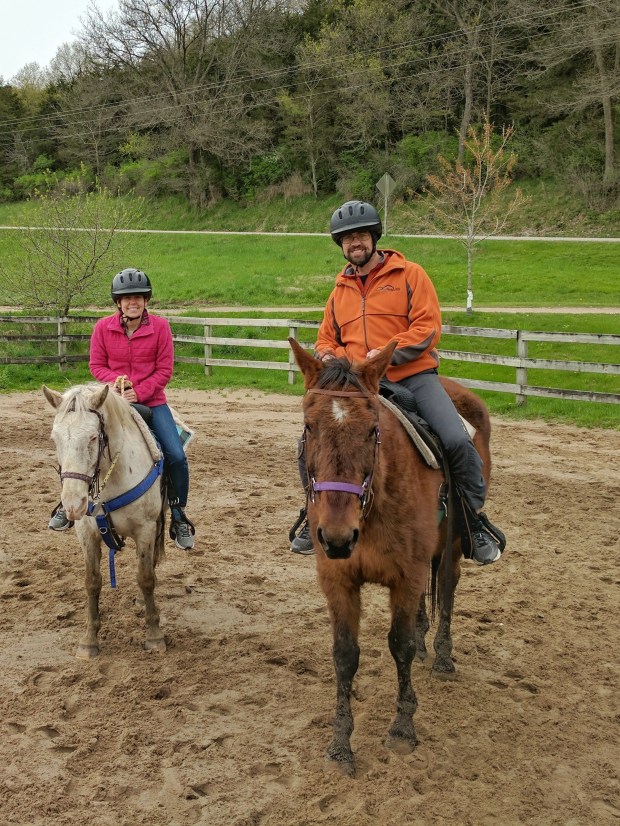
Speaking of horses… Riding one can be a challenge. Especially when you’re doing it for the first time!

Though I had taken some ‘pony’ rides as a kid, riding a horse at Village Creek Bible Camp two years ago was my introduction to the ‘real thing’. After being outfitted with a helmet and given some basic instructions on how to use my voice, hands, and feet to get my horse moving, it was time to give it a try.

And off I went! Or not so much…

If you want to understand the humor of this scene, you need to know that not only do I have very little hand-eye-foot coordination, I also don’t do “right” and “left”. On top of that, my short term memory when given a quick list of instructions is close to zero. I had no idea what I was doing!

Thankfully, Tim and the other riders were there to help me, and after a few minutes, my horse and I were in business. I certainly wasn’t a professional, but we were moving and, even better, moving in the right direction. I was in control!

That is until we started doing the “fun” activities. Which included a relay where I had to “race” (😂) toward a barrel, slow down and get close enough to the barrel to grab an object from on top of it, navigate around the barrel (without knocking it over), and then “race” back. Needless to say, my team did not win!

Controlling my horse was hard, but you know what would have been impossible? Trying to also control someone else’s!

IMG_20170428_160216-02

In his letter to the church at Philippi, Paul spent a large portion of his words encouraging the believers to “complete [his] joy” by working on their relationships with one another (2:2). He filled up a whole paragraph with instructions to be like-minded, loving, tender, compassionate, others-focused, and humble (2:1-11).

He then followed those words with this verse: “Therefore, my dear friends, as you have always obeyed—not only in my presence, but now much more in my absence—continue to work out your salvation with fear and trembling” (2:12). At first glance, this verse doesn’t seem to fit into a discussion about unity and relationships, but it may actually be the key verse of the whole chapter.

“Salvation” is a spiritual process. Though our “sin” exists in the physical, its debt and true consequences are in the spiritual, meaning our liberation from it first happens in the spiritual. But it doesn’t stay there. We live in the physical, so salvation must be “work[ed] out” in the physical – and the place where it gets the greatest workout is in our relationships.

You would think that among those of us who are “saved,” it would be easy to work as a like-minded, loving, tender, compassionate, others-focused, and humble team. But obviously it’s not or Paul wouldn’t have needed to write about it!

Living according to Paul’s instructions is hard and it’s mostly hard because we forget about the “fear and trembling” part. I like being “saved”. I like knowing that I’m forgiven and that the Holy Spirit is working in my life to change me. But, it’s easy to get comfortable and start thinking I’m somehow in control of my horse – and everyone else’s.

If I was in control of how “salvation” works, everyone would “get it” right away and change would happen fast! All those hurts, habits, and hang-ups would disappear and we’d get moving to share Jesus with the world!

But how quickly I forget the length of time it took for me to “get it” and that change in me hasn’t and isn’t happening anywhere close to my timeline. If I can’t even rein in my own horse, why do I think I can reach over and control someone else’s?

To “work out” my salvation with “fear and trembling” is to remember that the God who saved me is still the God who is saving me – and everyone else I come in contact with. I deserved wrath, but instead have been showered with mercy. I did nothing to deserve it – and neither has anyone else. He’s the one who “reigns” and His reign is over all (Psalm 93:1). His work in people’s lives is His work and because He’s God, He knows how to do it best.

When we walk out of that place of “fear and trembling,” pride becomes our god and we start trying to grab each other’s reins. But when we stay there, like-minded, loving, tender, compassionate, others-focused, and humble teamwork is possible!

Enter your email address to subscribe to this blog and receive notifications of new posts by email.

Narnia

If you haven’t read the “Chronicles of Narnia” books, perhaps you’ve seen the movie or at least heard of the magical storybook land. Sung into existence by Aslan the Lion, and under his powerful and faithful protection, Narnia is a place unlike any other – and especially unlike its neighbor to the south – Calormen.

Which is where the third chronological book of the series, “The Horse and His Boy,” (which Ada and I are currently reading) begins. Calormen is a country ruled by a monarch called the “Tisroc” (whose name, when spoken, must be followed by the phrase “May he live forever”) and a ruling class called the “Tarkaans”. But more than the monarch himself, the forces of rank, entitlement, and therefore, strife, preside over Calormene society.  

IMG_20190219_115415-01

The main character is a boy named Shasta who, as we are introduced to him, is about to be purchased by a Tarkaan to become his slave. But while the transaction is being finalized, Shasta meets the Tarkaan’s horse – who just happens to be a talking horse from Narnia. Shasta listens as the horse, whose name is Bree, describes his homeland:

“Narnia,” answered the Horse. “The happy land of Narnia—Narnia of the heathery mountains and the thymy downs, Narnia of the many rivers, the plashing glens, the mossy caverns and the deep forests ringing with the hammers of the Dwarfs. Oh the sweet air of Narnia! An hour’s life there is better than a thousand years in Calormen.”*

It turns out that Bree, who had been kidnapped and brought to Calormen, was waiting for an opportunity to escape and return to Narnia, but needed a rider in order to not be captured for being a ‘stray’ horse. Shasta, also eager to escape, agrees to be his rider. Bree is slightly concerned, though, as young Shasta has never ridden a horse – which leads to this very important part of the conversation:

“Poor little beast,” said the Horse in a gentler tone. “I forget you’re only a foal. We’ll make a fine rider of you in time. And now—we mustn’t start until those two in the hut are asleep. Meantime we can make our plans. My Tarkaan is on his way north to the great city, to Tashbaan itself and the court of the Tisroc——”

“I say,” put in Shasta in rather a shocked voice, “oughtn’t you to say May he live forever?”

“Why?” asked the Horse. “I’m a free Narnian. And why should I talk slaves’ and fools’ talk? I don’t want him to live forever, and I know that he’s not going to live forever whether I want him to or not. And I can see you’re from the free north too. No more of this southern jargon between you and me! And now, back to our plans.”*

Being a “free Narnian” meant that Bree had no obligation to bow to the Calormen monarch. Even though he existed in Calormen and even though he could have faced consequences for not saying “May he live forever,” he didn’t because he knew he didn’t have to. Bree knew something greater, Narnia, existed and he knew he was securely a citizen of Narnia, and so he was able to exist within Calormen, but not be enslaved to its forces.

The “Calormen” that we live in isn’t much different. Instead of the Tisroc, though, it’s our own fragile egos that we hold up and bow down to in worship, “May they live forever!”. Balanced on the pedestal of our own moral or personal superiority, we can’t help but criticize (and panic at the slightest criticism of ourselves). Obsessed with getting what we believe we’re owed, we walk in entitlement (and then can’t.handle.life. when we don’t get what we think we should get). Turning all of our energy toward the uplifting of the “self,” we’ve become angry, stressed, and depressed.

In his gospel, John tells us that Jesus knew “that he had come from God and was going back to God” (John 13:3). Jesus existed in this land of rank, entitlement, and strife, but because He knew something so much greater existed and that He was securely part of that and returning to that, He did not ever, even for a second, bow down to those forces. Rather than pulling rank, demanding what was rightly his, or striving in competition, He “emptied himself, by taking the form of a servant” (Philippians 2:7).

And contrary to our instincts, the result of this emptying and service was not anger, stress, or depression – it was freedom. Because Jesus did not exert all of His energy in the grasping and lifting up of His human ego, He was released from slavery to it.

As a follower of Jesus and a citizen of the kingdom of heaven, I have a secret! I know about “Narnia”. I know there is something greater than all this rank, entitlement, and strife, and I know I’m securely a part of it. As a “free Narnian,” I don’t have to bow down to my own fragile ego. I don’t have to worry that someone’s going to push me off my pedestal – because I know I don’t belong there anyway. I don’t have to be disappointed when people don’t give me what I want – because I already have everything I’ve ever needed in Jesus. I don’t have to be offended when someone doesn’t lift me up – because I’ve already been given the greatest uplifting ever as a child of God.

Liberated from the burden of having to hold my “self” up, I’m free to follow Jesus’ example. If I’m not busy making a big deal about me, then I’m free to “count others more significant than [myself]” (Philippians 2:3). If my mental space isn’t consumed by figuring out how to get what I’m owed, I’m free to look “to the interests of others” (2:4). Without carrying the weight of a heavy shield of defense, I’m free to “do all things without grumbling or disputing” (2:14).

Although Bree the talking horse was born in Narnia, he had lived the majority of his life in Calormen. So though he knew about Narnia, he had some anxiety about returning there.

Near the end of the journey, Bree encounters a friendly Hermit who gives him some advice:

“It doesn’t follow that you’ll be anyone very special in Narnia. But as long as you know you’re nobody very special, you’ll be a very decent sort of Horse, on the whole, and taking one thing with another.”*

Contrary to our instincts, freedom comes from the surrender of self rather than the exalting of it. Holding my ego up is an exhausting, 24/7/365, full-time job that Jesus has released me from!

*”The Horse and His Boy” by C.S. Lewis

Enter your email address to subscribe to this blog and receive notifications of new posts by email.

Overcorrect

Speaking of driving… You know those video games where you have to drive a car or steer some sort of random wheeled object along a narrow, winding, hazard-filled course? I’m terrible at them. While some people (i.e. my husband and children) hit every speed-boost, avoid every obstacle, and make every turn with ease, I miss every boost, hit every obstacle, and crash on every corner!

Because I’m a chronic over-corrector.

Though some seasoned video-game-drivers have the patience and skill to navigate a course, I’m an impatient panic-er! I see myself headed toward a wall, so I steer left as hard as I can. Which immediately sends me headlong into the wall on the left. And when I see that coming, I jerk the controls back to the right and you know what happens next – CRASH!

00100dPORTRAIT_00100_BURST20190212151259981_COVER-01

Us over-correctors know the struggle applies not only to video games, but to the rest of life as well.

When I see a flaw in my self, I want to fix it. I’m aware of the wall I’m about to run into and, in my attempt to avoid the crash, I send myself headlong in the other direction. It seems so clear in the moment: “This is what I need to do and I’m going to do it!” But then I try and no matter how hard I try to steer that wheel in the right direction, I can’t seem to control myself and I end up flailing toward some ticking-time-bomb hazard and blowing up anyway.

It’s hard to rest when there’s so much work to be done on me. Following Jesus means transformation, and even though I’m not who I once was, I’m still not the follower I’d like to be. And it’s not just about me – all the people I interact with would certainly benefit from my transformation as well!

In his letter to the Romans, Paul follows up his presentation of the gospel message with a practical application of our salvation:

Therefore, I urge you, brothers and sisters, in view of God’s mercy, to offer your bodies as a living sacrifice, holy and pleasing to God—this is your true and proper worship. Do not conform to the pattern of this world, but be transformed by the renewing of your mind. (Romans 12:1-2a)

Paul goes on to talk about the transformed life as it works itself out in our relationships, summing it up with these words in chapter 15:

May the God who gives endurance and encouragement give you the same attitude of mind toward each other that Christ Jesus had, so that with one mind and one voice you may glorify the God and Father of our Lord Jesus Christ. (Romans 15:5-6)

In both of these passages, the important thing to note are the verbs that indicate how the change in us happens. Notice that we are to “be transformed,” not “to transform” and that it is God who “gives” us the attitude of mind that Christ Jesus had, not ourselves. It’s also important to note the “so that” which is the motivation behind His work.

There are many “pattern[s] of this world” we are tempted to conform to, but one of the most dangerous is the self-help model. Motivational quotes, books, and articles promise a “better” you if you’ll just take these three easy steps. The “you” you want to be is within your reach! Put in the work and that “self” you’ve always desired will be yours.

The problem is that nothing in the self-help model matches up with Romans 12:1-2 or 15:5-6. Because there’s nothing in there about a “better” me or three easy steps. I don’t see the “me” I want to be listed in there as a goal. And the only “work” mentioned is a word that implies the opposite of “self”-help.

Offering my body as a sacrifice means just that – sacrifice. The “me” I want to be is being laid on the altar along with “my” desire to change “me” so I can be “better”. Offering something means releasing ownership of it and offering me means giving up my attempts to perfect “me”.

Self-help leads to extremes because our “selves” are hard to control. But when I offer myself, I rest. It’s not that effort is not required, it’s that the focus of my effort is no longer on changing myself. Rather, my effort is directed in the offering of myself, on a moment by moment basis, submitting to God so that His glory might be displayed in me.

I’ve been convicted as I write this that even my most noble efforts at change are still “self” focused. Because even if my goal is to have a “better” marriage or be a “better” parent, it’s still rooted in my own fulfillment! I need to change that! 😉

I’m so glad God is not in a hurry to make me the “me” I want to be and that even in my overcorrecting He’s still working. The “me” He wants me to be is His work in progress and He’s got all the patience and skill needed to make it happen!

Enter your email address to subscribe to this blog and receive notifications of new posts by email.

Bumps

Speaking of our elementary school… It’s only a block or so from our house, but I never drive by it.

Why? You might ask.

Speed bumps! I would answer.

Unless I am going to the school for an event, I avoid that section of Caley Road at all cost. As I do with Keebler and several other roads in our area. I will take the long way around (even if it takes more time) because I do not like my sense of movement to be interrupted!

IMG_20190205_161021-01

Nothing hinders “rest” in our lives than bumps in the road. We had a plan, we saw the vision of where we were headed, and we were moving in that direction at a good pace. But then ughhh – something came up and slowed us down. We think we’ve finally got it together, but a change in circumstances stalls the progress. Or someone we thought we could depend on isn’t coming through with their piece of the puzzle. We like our plans to work out and when they don’t seem to be, we get restless.

As a speed bump avoider, I can relate to King Saul’s predicament in 1 Samuel 13. Having gathered troops for battle with the Philistines, Saul’s instructions were to wait for the prophet Samuel, who would offer a sacrifice to the Lord before the battle. The massive Philistine army had approached and encamped, and Saul’s troops were “quaking with fear”. So…

He waited seven days, the time set by Samuel; but Samuel did not come to Gilgal, and Saul’s men began to scatter. (v. 8)

Ughhh. Speed bump. This was not part of the plan! With his chances of winning the battle shrinking by the minute, he had to get things moving.

So he said, “Bring me the burnt offering and the fellowship offerings.” And Saul offered up the burnt offering. (v. 9)

But…

Just as he finished making the offering, Samuel arrived, and Saul went out to greet him.

“What have you done?” asked Samuel.

Saul replied, “When I saw that the men were scattering, and that you did not come at the set time, and that the Philistines were assembling at Mikmash, I thought, ‘Now the Philistines will come down against me at Gilgal, and I have not sought the Lord’s favor.’ So I felt compelled to offer the burnt offering.” (v. 10-12)

Like Saul, my restlessness always leads to me feeling “compelled”. Compelled to speed things up a little. Compelled to keep moving to avoid the angst of sitting still. Compelled to take things into my own hands.

“You have done a foolish thing,” Samuel said. “You have not kept the command the Lord your God gave you; if you had, he would have established your kingdom over Israel for all time. But now your kingdom will not endure; the Lord has sought out a man after his own heart and appointed him ruler of his people, because you have not kept the Lord’s command.” (v. 13-14)

That “man after [the Lord’s] own heart” was David, the writer of these words:

In the morning, Lord, you hear my voice; in the morning I lay my requests before you and wait expectantly. (Psalm 5:3)

I remain confident of this: I will see the goodness of the Lord in the land of the living. Wait for the Lord; be strong and take heart and wait for the Lord. (Psalm 27:13-14)

Lord, I wait for you; you will answer, Lord my God. (Psalm 38:15)

I waited patiently for the Lord; he turned to me and heard my cry. (Psalm 40:1)

When we trust, we rest. There’s no fast-track to God’s plan, and I’ve found that more often than not, He builds the bumps into our routes to force the drop in speed and, in that, reveal whether our hearts are after His plans or our own.

What’s your “Samuel” today?

God, I thought ________________ was part of the plan and that it would have happened by now. Help me to trade my restlessness for trust so I’m no longer compelled to do things my own way. Amen.

Enter your email address to subscribe to this blog and receive notifications of new posts by email.

Walk

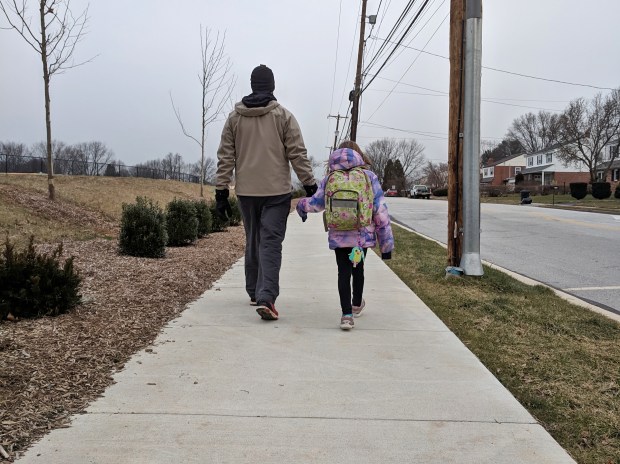
Since we began our elementary school journey seven years ago, we’ve endeavored to be a “walking” family. The exercise and fresh air are good for our souls and from door-to-door the trip is only about ⅓ mile.

Or it was until construction began.

When our school began construction two years ago, the sidewalk going in our direction was closed, which extended our walking distance. We now had to walk an extra block-ish, cross the road, and then walk back toward the school entrance. We couldn’t wait for construction to end and our shorter route to be restored.

And as of this November, it was!

But then this happened:

1472267601

You see that crosswalk? The shortest route to the first-grade entrance is obviously to cross there and continue to the right. But we have it on good word that, rather than cross where buses are coming in and out of the loop (red), school authorities would prefer that students cross where there is little to no traffic (green). Our “shorter” route has not been restored!

If you’re a rule-following kid, your rule-following parents are your heroes. If you’re an oblivious-to-the-rules kid, your rule-following parents just confuse you. But if you’re an above-the-rules kid, your rule-following parents drive you crazy!

Yes, we could take the shortcut and cross the bus loop (we’re basically holding her hand, after all). But we don’t. And though every step of that extra loop at first seemed a mile long, it’s now become part of our routine (and we don’t even get many complaints anymore 😉).

In 12+ years of parenting and 20+ years of youth ministry, I’ve learned a lot. I’ve learned do’s and don’ts, tips and tricks, but mostly I’ve learned that I could do everything right and still not ‘succeed’. Because there are some giant factors outside of my control. No matter how hard I try, I will never be able to cleanse my children from their particular sin patterns or prevent the struggles that are inherent in their personality and temperament.

But through all I’ve observed and experienced, I have narrowed down the one thing I can do that will affect my children more than anything else: REST.

Whether we like it or not, our stress levels affect our kids. We know this, but we also know stress is a part of life that will never be eliminated. Tight schedules, long to-do lists, relationship tensions, health woes, and difficult decisions are our every day. Who has time to rest? (Especially when you have kids!)

The cool thing about “rest,” from a biblical perspective, is that it doesn’t necessarily mean stopping. Rest, in most instances in the Bible, exists simultaneously with movement:

This is what the Lord says:
“Stand at the crossroads and look;
   ask for the ancient paths,
ask where the good way is, and walk in it,
   and you will find rest for your souls.”
(Jeremiah 6:16)

“Rest for your soul” is a natural product of walking in obedience. Though we tend to think of obedience as a burden – something to add to our already long list of stressors – it’s the opposite. Rest is found when we seek God’s ways and then actively walk in them.

Jesus was our ultimate example of the “rest for your soul” kind of life – and not just when He was sleeping on the boat! 😉 Jesus entered into all kinds of stress-filled situations, but in the midst of those situations, He exuded peace because He lived in complete trust that the path His Father had for Him in that moment was nothing but “good”.

Whether your stress is in the daily grind or you’re under an unusually heavy weight, “rest for your soul” happens when you “ask where the good way is” and then “walk in it,” reminding yourself that each step leads to your good and God’s glory.

Our steps of obedience can at times feel painstakingly unnecessary, but with each step our trust increases. Over time, trust becomes a way of life and that way of life looks a lot like “rest”.

Being a rule-following parent may drive your kids crazy now, but someday they’ll thank you! 😎

img_20190129_084059-01

Enter your email address to subscribe to this blog and receive notifications of new posts by email.

Melt

When “winter weather” threatens Pennsylvania, people get real excited. Weather reports and warnings flood our screens, grocery stores are mobbed with shoppers preparing for the worst, and everything shuts down.

We (former) *Vermonters*, however, like to sit back and laugh. Because where we grew up a little bit of snow was just a little bit of snow!

Last week, we woke up to a fresh coating of white and like true (former) *Vermonters* we looked out and said, “No big deal!” While others may have been out shoveling and clearing, we did nothing. When we walked through the ½ inch of powder to the cars on our very sloped driveway, we thought, “What’s a little snow? It’s just going to melt soon anyway!”

Until that evening when that fresh coating, which had partially melted during the day, froze to form a sheet of ice!

You would love to have had a hidden camera on our driveway over the next couple of days. Getting us and our kids and our stuff in and out of our cars while using all of our grip strength to avoid landing on our backs was a sight to be seen. The funny thing is, it wouldn’t have taken that long to walk the 20 feet into the carport, grab a cup of ice-melting rock salt from the bag and fix the problem!

But we’re *Vermonters* remember?

(Or maybe we’re just lazy 😜)

img_20190122_115755-01

As humans, we are prone to taking this (former) *Vermonter* approach to our hearts. We know something might not be quite right, but it doesn’t seem like a big deal, and surely it will go away soon! The development of dangerous hardness in our hearts (see last week’s post) isn’t something we ever see coming.

Thankfully, God hasn’t left us alone to figure it out – He’s given us churches full of friends to become our hard-heart-melting rock salt.

The idea of using salt to melt ice is has always confused me. When the salt is spread, it comes in contact with the wet outer layer of the ice and dissolves. In that process, it (somehow) lowers the freezing temperature of the molecules it comes in contact with, and with the freezing temperature lowered, the ice is ‘tricked’ into melting at that lower temperature. Not a scientific explanation, I know, but that’s how I see it 😉

A salty friend “sticks” (Proverbs 18:24) close, but not just for their own benefit. They are studiers of “you” and it’s through them and their outside perspective that God’s loving “truth” (Ephesians 4:15) is sprinkled on your heart. The truth may feel like a “wound” (Proverbs 27:6) because at first it feels cold, but that’s where the melting process begins.

A salty friend is someone who gets you but doesn’t always agree with you.

A salty friend cares about you, but also cares enough to gently nudge you off your high-horse when the frost of pride is settling in.

A salty friend dreams with you about what could be, but is also willing to burst your bubble when you might be taking on too much.

A salty friend listens to you vent, but ends the conversation by reminding you how much you have to be thankful for.

A salty friend listens, but doesn’t hesitate to interrupt and point out that your view of a situation has excluded trust in the God who is above it all.

img_20190122_115449-01

If you want to know if a storm is coming to our area, you don’t need to check the weather forecast, you just need to take a drive and see if they’ve “sprayed” the roads with salt brine yet. Science and the transportation authorities have figured out that prevention of the freeze is the best way to remedy it!

When it comes to hard hearts, prevention of the freeze by talking regularly with a salty friend is the best remedy.

Building intentional friendships with other believers is all kinds of hard. It can be awkward and bring out the *middle-schooler* in us. It can take longer for these friendships to develop than we think it should and the process requires extra flexibility as our seasons constantly shift. You may wonder if you really even need this in your life!

But you do. The stuff in your heart may seem like a little bit of powder, but the hidden camera on your driveway is revealing a different story!

If you have a salty friend, thank them today.

If not, what’s one step you can take toward making that happen?

Enter your email address to subscribe to this blog and receive notifications of new posts by email.