Counted

As Eleanor Shellstrop’s eyes open in the first scene of NBC’s “The Good Place,” she is greeted with assurances that she is okay and everything is going to be fine. Having passed away in a freak shopping cart accident, Eleanor is now, as afterlife agent Michael informs her, in ‘the good place’.

Relieved, Eleanor begins to settle into her new surroundings. But as Michael describes the process by which she was allowed in, she becomes uneasy. “When your time on earth is ended,” Michael explains, “we calculate the total value of your life using our perfectly accurate measuring system.”

From a giant screen, Michael displays for the day’s ‘good place’ newcomers some sample actions and the positive or negative point values associated with them – implying that their every action on earth was counted for or against them. “Only the people with the very highest scores – the true cream of the crop – get to come here,” Michael concludes.

Counted PHOTO 1

Sure that there’s been a mistake, Eleanor begins to panic. Her life on earth was in no way ‘good’ and she doesn’t deserve to be here!

Of course this show is meant to be a comedy, not a theology documentary, but it does play on our society’s perception of religion. It seems ingrained in our minds that in the end our deeds will be tallied and as long as our ‘positive’ numbers add up, the ‘negatives’ will be overlooked and we’ll earn our ticket into an eternal ‘good place’.

This isn’t a new problem. In chapter 4 of his letter to Romans, the apostle Paul presents his case against this counting mentality. “Now to the one who works,” Paul says, “his wages are not counted as a gift, but as his due.” (Romans 4:4) Since doing ‘good’ requires more effort than doing ‘bad,’ it’s natural to conclude that those who put in the work should earn something in return.

But, using Abraham as an example, Paul points out that God’s counting process only involves one action: faith. “Faith was counted to Abraham as righteousness” (v. 9) because he was “fully convinced that God was able to do what he had promised.” (v. 21) Did you catch that? He was convinced that God was able, not that he was. A counting mentality focuses on myself and what I can do, but faith focuses on what God can do.

Paul sums up his point by saying that, like Abraham, righteousness “will be counted to us who believe in him who raised from the dead Jesus our Lord, who was delivered up for our trespasses and raised for our justification.” (v. 24-25) It’s not about a magic moment when you “accept Christ” and “become a Christian” – it’s about a choice to acknowledge that you aren’t able to count up enough points to attain righteousness, but that God is able to do what He has promised and make you righteous by the merit of Jesus alone.

Counted PHOTO 2

There’s an unexpected twist at the end of the season finale of “The Good Place”. (*SPOILER ALERT!*) After spending the in-between episodes trying to become ‘good’ and avoid being evicted from the good place, Eleanor discovers it’s all a lie – it turns out they’ve been in the bad place the entire time! The whole thing was Michael’s elaborate plan to torture humans in a way they’d never been tortured before.

The most shocked by this revelation is Tahani, a wealthy philanthropist who thought for sure she had earned her way to the good place with her acts of charity and generosity. But what she thought counted for her actually counted against her as all that ‘positive’ was overtaken by a single ‘negative’ – her desire for recognition. In the end, even our best deeds count against us because of the self-focused motivation behind them!

In verses 7 and 8, Paul quotes Psalm 32: “Blessed are those whose lawless deeds are forgiven, and whose sins are covered; blessed is the man against whom the Lord will not count his sin.” Putting our faith in Jesus means trusting that not a single one of our ‘negative’ actions will be counted against us (nope, not even using “Facebook” as a verb or blowing your nose by pressing one nostril down and exhaling!).

But just because they’re not counted against us, doesn’t mean they’re overlooked.

In Paul’s quotation of Psalm 32, he uses a Greek word we translate as “forgiven” which means to “send away” or “release”.* But in the original Old Testament Hebrew, the word for “forgiven” means to “lift” or “take”.** When we say God has “forgiven” our sin, it doesn’t mean He’s just eliminated the negative or “sent it away” – it means He’s released us by “taking” the debt and counting it against Himself.

Unlike Eleanor Shellstrop, we don’t live in fear that the promise of eternity in Heaven will be taken away from us – because we didn’t earn it or ever deserve it in the first place!

*http://biblehub.com/greek/863.htm
**http://biblehub.com/hebrew/5375.htm

Enter your email address to subscribe to this blog and receive notifications of new posts by email.

Filled

There’s one thing that makes the cold weeks of February bearable. It’s not the Super Bowl (even though WE WON THE SUPER BOWL! 💚🦅🎉💚 Fly Eagles Fly!). It’s not Tim’s birthday (although he may have gotten his favorite birthday present ever – see previous sentence). It’s not Punxsutawney Phil seeing or not seeing his shadow. It’s not even Valentine’s Day.

It’s Valentine’s Day at Dunkin’ Donuts. There’s something about a heart-shaped donut filled with vanilla buttercream, Bavarian cream, or brownie batter that makes your troubles melt away. Whoever invented the idea of leaving empty space in a pastry so it could be filled with all that good stuff was a genius!

FILLED 3-01

Long before donuts were created, Adam and Eve knew something about the good stuff. In the Garden they lived a full life, knowing nothing but wholeness in their relationship with God. They lived in total openness, completely bare before Him. They experienced full satisfaction and didn’t know the meaning of “need”.

But then one day someone convinced them they were missing something:

The serpent was the shrewdest of all the wild animals the Lord God had made. One day he asked the woman, “Did God really say you must not eat the fruit from any of the trees in the garden?”

“Of course we may eat fruit from the trees in the garden,” the woman replied. “It’s only the fruit from the tree in the middle of the garden that we are not allowed to eat. God said, ‘You must not eat it or even touch it; if you do, you will die.’”

“You won’t die!” the serpent replied to the woman. “God knows that your eyes will be opened as soon as you eat it, and you will be like God, knowing both good and evil.”

The woman was convinced. She saw that the tree was beautiful and its fruit looked delicious, and she wanted the wisdom it would give her. So she took some of the fruit and ate it. Then she gave some to her husband, who was with her, and he ate it, too. At that moment their eyes were opened, and they suddenly felt shame at their nakedness. So they sewed fig leaves together to cover themselves. (Genesis 3:1-7 NLT)

As she listened to the serpent’s words, Eve for the first time experienced “lack”. There was wisdom she didn’t have and without it she wasn’t complete. And in his shrewdness, the evil one not only made her aware of the hole, he also made her aware of an alternative way it could be filled.

In the end, though, this “filling” only created a much larger hole as Adam and Eve were now aware of the gap between themselves and God. In one moment, openness turned to hidden and whole became empty.

But when Jesus came, He came to make “life to the full” possible again (John 10:10). He lived, died, and rose again so that the Holy Spirit could come and “fill our hearts with his love” (Romans 5:5). He made it possible for the empty space in our souls to be filled “with all joy and peace” and even “overflow with hope” (Romans 15:13).

Our enemy hasn’t changed his tactic – he still loves to point out our holes. He knows he can’t take anything away from us, but he can make us aware of the areas where we lack. He can make sure we know we’re not enough by lining up our weaknesses next to other people’s strengths. And one quick browse through social media can be all it takes remind us that our hearts aren’t as “full” as everyone else’s seem to be.

But it turns out the holes are on purpose. God allows us to be incomplete so He can complete us – and the filling is the best part! Every area where we see a lack is a place where God can come in and fill us with more of the good stuff of Himself.

FILLED (2)-01

One of my biggest dreams is to be able to share the curriculum I write for our youth with a greater audience – I work so hard on this stuff and surely someone out there could benefit from it! But last week I made the mistake of following a social-media-profile-trail of published youth curriculum writers. With every click I became painfully aware of another “I’m not…” – not smart enough, not ‘hip’ enough, not young enough – which eventually turned into “Why would anyone ever want to hear from me?”

It took me a couple days to snap out of my funk, but what did it was remembering that all that lack is just more opportunity for the Holy Spirit to do His thing (if that’s what He chooses to do). If I was “all that,” there would be no room for Him to do His own work – and isn’t that the point?

If you’ve given your life to Christ, then the presence of the Holy Spirit, richer than the richest Bavarian cream the world has to offer, is available to you. So every time you’re made aware of a lack, take it as an opportunity to ask Him to fill you with more of the good stuff!

What’s a hole or lack in your life that the Holy Spirit has been able to fill?
Leave a comment below!

Enter your email address to subscribe to this blog and receive notifications of new posts by email.

Litter

Growing up means learning about right and wrong. Growing up in Vermont means learning about right and wrong as it pertains to the environment. Maybe it was just the 1980’s “Reduce, Reuse, Recycle” movement, but I grew up in a state that took caring for the environment very seriously. My conscience was shaped by an understanding that trash must be taken care of appropriately – a good person recycles, a bad person does not, and an evil person litters their trash all over the sides of the road!

Over the years, a picture formed in my head of these ‘sinners’. Obviously their cars were a mess! Too lazy to properly dispose of their debris, they tossed it on their car floors and when their cars got too messy, they started chucking it out the window, leaving it for someone else to clean up.

Or so I thought.

It wasn’t until many years later that I discovered the truth: People who are littering have clean cars! Not wanting to give the appearance of untidiness for even a few minutes, they get rid of any trash immediately. Rather than go through the (sometimes complicated) disposal process, they take the easy route and make it someone else’s problem.

IMG_20180130_133640-01

As the Son of God, Jesus knew what He was getting Himself into when He came to earth. Having existed for eternity, He knew the state of the human condition and knew very well that His experience would be anything but pristine and polished. Though He carried in Himself the pure, uncontaminated righteousness of God, He plunged head-on into the mess of humanity.

But even with all that righteousness – even though as the Son of God His understanding of right and wrong was completely just (John 5:30) and even though He had “perfect knowledge” (Job 37:16) of every deed (Hebrews 4:13), every heart (Psalm 33:15), every desire, and every thought (1 Chronicles 28:9) – He did not spend His time diagnosing sin. Though He could have accurately judged every person He encountered, He suspended His judgment.

Well, most of it, that is. He didn’t hold back when it came to one group – the Jewish religious leaders. From a moral perspective, these men appeared to be living clean lives. They outwardly demonstrated obedience to the religious customs and teachings of the Torah, and because of their confidence in their own righteousness, they felt at liberty to look around and declare others to be “sinners”.

But in Matthew 23, Jesus pointed out that “Everything they [did was] done for people to see” (v. 5) and “they [did] not practice what they preach[ed]” (v. 3). He said to them, “Woe to you, teachers of the law and Pharisees, you hypocrites! You are like whitewashed tombs, which look beautiful on the outside but on the inside are full of the bones of the dead and everything unclean. In the same way, on the outside you appear to people as righteous but on the inside you are full of hypocrisy and wickedness.” (v. 27-28)

By drawing attention to the sins of others, the Pharisees succeeded in avoiding the work of properly disposing of their own trash. But, being so intent on keeping their image clean, they missed out on experiencing the full character of God. And what made Jesus so angry was that they prevented others from fully experiencing Him as well.

I’m a (self-diagnosed) diagnoser. Every action has a reason and I’m constantly analyzing the cause and effect of people’s behavior. When someone does something that upsets or frustrates me, I determine the root cause of it (usually some sort of sin, of course) and then find a sympathetic ear to share my diagnosis with. (Because, thankfully I’m not like that.)

But over the past few weeks, I’ve been convicted (I guess that’s what happens when you do a Bible study called “Discerning the Voice of God” 😜) about my words. When I form a diagnosis, I feel an urgent need to tell someone – but why? What’s my motivation? When I allow the Holy Spirit to be the real Diagnoser, I see the root cause – believing my knowledge to be perfect and my judgment to be just, I’ve built myself up to take God’s place as judge.

In his sermon on “Judging Others” two weeks ago, our pastor reminded us that we always have the choice to suspend our judgment.* “Suspending” for me means pushing pause and checking my motivation before I share my thoughts. It doesn’t mean I’ll never say it and it doesn’t mean I’m not right (I may very well be!), it just means I don’t need to say it right now. And in those moments I’ve felt the nudge to “suspend,” I’ve looked back a few minutes or hours later and chucked my diagnosis right out the window because sharing it had no benefit for anyone!

IMG_20180129_142037-01

If you’ve ever gone for a ride in our car, you’ve seen our mess. I cringe every time the elementary school drop-off line helper opens the door to let my kids out because you never know what’s going to come tumbling out of there! Sandwich bags full of crushed snacks, open containers of Chick-Fil-A sauce, broken plastic cups – you name it, it’s probably in the back of our car!

We’ve all got trash in our lives. We can pretend it’s not there or try to throw it out the window, but until we take it through the proper disposal procedure, it’s going to remain a burden. Jesus came not to judge the world, but to make a way for us to exchange our mess for mercy. It may not be tidy, but it’s not complicated – it’s a single-stream process and we can hand it all over to Him – judgment of others (and judgment of others’ judgment) included!

*http://hope-cc.org/watch “ROMANS: Part 3: Judging Others” by Roman Kupecky (January 21, 2018)

Enter your email address to subscribe to this blog and receive notifications of new posts by email.

Warm-Up

I love running. There’s nothing like getting out on the trail, putting one foot in front of another, and checking off the miles. It’s my fresh air, my exercise, and my alone time all in one!

But no matter how much I love running, in winter my dread of the cold will always win. Even though I know I will be perfectly warm in less than half a mile, I still can’t get myself to get all dressed up and get out the door. (Except yesterday. 60° and sunny on January 23 – what?!?)

Winter for me means it’s time for indoor workouts. And thankfully there are tons of them on YouTube!

A few weeks ago, I tried a new ‘high intensity’ cardio and strength training workout. As the video began, though, I was annoyed at the lame warm-up exercises. This workout needed to replace several miles of running and I was promised 45 minutes of intensity, so I wanted intensity! These simple moves were certainly not profitable for strength or cardio training. So I began adding my own ‘flair’ to the exercises to make them more ‘intense’.

If you know anything about working out, you know what happened next. Not even two minutes in, I pulled something in my back and that was that. 45 minutes of high-intensity movement turned into 20 minutes of low-intensity stretching. It turns out warm-ups exist for a reason!

WARMUP (1)-01

Obedience is a funny thing. Even when given instructions by experts or professionals, something inside of our human selves believes we know better and wants to go our own way. Though we ourselves seek out this advice, we have a hard time following it when we don’t see it as profitable to our immediate situation.

This year I’ve made it my goal to learn more about what it means to listen to God. I want to know what He wants me to do, but I’m never sure if I’m hearing His voice or my own! I hear people tell stories of the Holy Spirit “leading” them to do certain things, but how do I know what He’s leading me to do?

My ‘theme verse’ for the year is found in the fifth chapter of Luke:

When he had finished speaking, he said to Simon, “Now go out where it is deeper, and let down your nets to catch some fish.”
“Master,” Simon replied, “we worked hard all last night and didn’t catch a thing. But if you say so, I’ll let the nets down again.”
(Luke 5:4-5)

As a fisherman, Simon (Peter) knew a lot about his trade. He knew the ideal time of day to throw out the nets and he also knew that if you’ve worked all night (the ideal time) and haven’t caught anything, then going out again during the day (a non-ideal time) would never be a profitable solution! So rather than simple, immediate obedience, Peter first made sure he got his two cents in about why he shouldn’t do it in the first place.

What Jesus asked him to do did not seem like a profitable endeavor, but what Peter said next is my favorite: “But if you say so”. Though he believed he knew better, Peter decided to take Jesus at his word and do it anyway:

And this time their nets were so full of fish they began to tear! A shout for help brought their partners in the other boat, and soon both boats were filled with fish and on the verge of sinking.
When Simon Peter realized what had happened, he fell to his knees before Jesus and said, “Oh, Lord, please leave me—I’m such a sinful man.” For he was awestruck by the number of fish they had caught, as were the others with him.
(v. 6-9)

With all the paralyzing over-analyzing my brain loves to do, what I wouldn’t give to be in the physical presence of Jesus and have Him vocally tell me exactly what to do! If I could hear actual words, there would be no questioning, “Is this from God or from me?” But knowing my track record, I would still respond like Peter – I would still think I know better!

Believing myself to be the expert on my circumstances and a professional predictor of the profit of an act of obedience, I regularly assess the risk, effort, or cost and decide it’s not worth it. It’s hard to see our small acts of obedience as having an intense impact on the world!

But the profit of our obedience is never the result of our actions – it’s the result of God working through our actions. We’re not Him, so our estimate of the outcome is limited, but He has the ability to make huge Kingdom gains happen from small movements.

The other day, while agonizing in my head as to whether or not God was leading me to do a thing, these words, “But if you say so,” came to mind. In that moment I realized that my debate was not over whether or not God was speaking to me – but rather my selfish nature coming up with a hundred reasons why I thought it was pointless!

WARMUP (3)-01-01

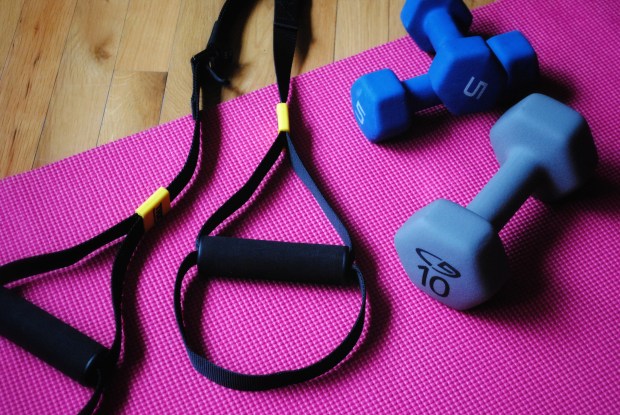
My ‘motivational purchase’ for this winter was a TRX suspension training system. Much cheaper (and way more introvert-friendly) than a gym membership, these straps take advantage of the forces of gravity and your own body weight to strengthen and tone muscles.

In the few weeks I’ve been doing these workouts, I’ve become very aware of the importance of my posture. When leaning your weight on the handles, your core must be engaged, your back straight, and your shoulders pulled back. If you want to benefit from these exercises, you have to pay attention to your position.

In her Bible study, “Discerning the Voice of God,” Priscilla Shirer says that the first and foremost thing we must do to hear the voice of God is to get ourselves into a “proactive stance of obedience”.* We must decide before we sense His leading that we will obey, even if we don’t think it will work!

We’ll never get it all right, but we rest in grace. It’s not about perfection, it’s about posture – you can never predict the profits of a heart positioned in a “But if you say so” direction!

*“Discerning The Voice of God” by Priscilla Shirer, p. 6

Enter your email address to subscribe to this blog and receive notifications of new posts by email.

Practice

“Try something new” day is one of the highlights of our summer vacations in North Carolina. After spending several days honing our skills at our favorite riding-some-sort-of-device-behind-the-boat activity, it’s time to leave our comfort zones and take a risk.

Not being a huge fan of water, “try something new” day for me means leaving my comfort zone behind my camera in the boat to “try something”! This year the rest of my family chose “wake surfing,” and I couldn’t pass up the challenge to try it myself. This fairly new sport involves pulling yourself up to a standing position on a very buoyant (and therefore wobbly) surfboard, letting go of the rope that connects you to the boat, and then freely “surfing” the boat’s wake.

Knowing that steps two and three would not be in my realm of possibility, I made it my goal to simply get to a standing position. Would it happen on the first try? Probably not, but I’d never find out if I didn’t try! So try I did. Once, twice, three times, four times. With each failure my chances of success were seeming less and less likely, but since the consequences of each failed attempt were low (perhaps some water up my nose and complaints from some children impatiently awaiting “their turn”) I was motivated to try and try again!

PRACTICE 01

In his November 2016 TEDx talk, learning expert Eduardo Briceño spoke of the difference between the “learning zone” and the “performance zone”. In the “learning zone,” he said, we “do activities designed for improvement, concentrating on what we haven’t mastered yet, which means we have to expect to make mistakes, knowing that we will learn from them.”* According to Briceño, successful people spend the great majority of their time in the “learning zone” where there the pressure is low and they give themselves the freedom to fail. When we see the consequences of our failed attempts as minimal, we’re more likely to attempt a skill and therefore learn it!

As Christians we spend too much of our time in the “performance zone”. We look at a possible ministry task or even a simple step of obedience like prayer or sharing our faith with others and believe the results to be dependent on our performance. When I examine my own life, it’s easy to see that the majority of my stress comes down to taking myself too seriously – I fear that I am inadequate to do what God has placed in front of me and fear that my attempt, when it fails, will negatively impact God’s work in my own or another person’s life.

The apostle Paul, after rising by his own merit to Jewish religious prominence, had an encounter with the glory of Christ that caused him to see himself for who he really was – a fragile human sinner just like the rest of us. His life completely changed course and now, by the merit of Christ and his submission to the leadership of God’s Spirit, Paul again took a leadership role as he traveled to share the gospel and set up new churches in areas where they didn’t exist yet.

But after his credentials were questioned by a church he helped start in the city of Corinth, Paul felt compelled to write a letter defending himself and his ministry. In that time, it was common practice (as it is for us now) for travelling speakers or those seeking employment to verify their education and skill by carrying “letters of recommendation” from an authority figure.* But because he believed his only qualification to be from God Himself, Paul did not carry such letters.

In 2 Corinthians 3:4-6a, he wrote: “Such is the confidence that we have through Christ toward God. Not that we are sufficient in ourselves to claim anything as coming from us, but our sufficiency is from God, who has made us sufficient to be ministers of a new covenant, not of the letter but of the Spirit.” (2 Corinthians 3:4-6a) Paul knew that any visible or notable skills he had weren’t even worth mentioning because, even at the highest level, they would not have made him “sufficient”.

Because of his assurance that it was all about God’s glory and not about his or his ministry partners’, Paul says in verse 12: “we are very bold”. Before Christ, the Spirit of God was only “upon” a single person or group of people at a time, but now the power and work of this same Spirit was available to every believer, and “where the Spirit of the Lord is, there is freedom.” Paul could continue on in bold freedom because he knew his acts of ministry were not his performance, but God’s alone.

Like Paul, we also have the ability to walk in ‘bold freedom,’ but how often do we allow our fear of making mistakes to keep us from even trying? It’s so easy to look at the ways we lack (in comparison to others) and believe God could never perform through our inferior selves. But what if, instead of living in the pressure of the “performance zone”, we stayed in the “learning zone”? What if we looked at every ministry task or step of obedience as practice and gave ourselves the freedom to make mistakes? What if, “Entrusting ourselves to Mystery [the Spirit’s unseen work], we move forward fearlessly, knowing that the future of the planet probably does not depend on what we do next”?*

PRACTICE 03

After several failed wake-surfing attempts that day this summer, I did finally get up on my feet! It didn’t last long as the board naturally ‘steers’ you toward the wake, and getting over that wave’s crest was a challenge my inferior balance wasn’t ready for. But at least I was up long enough for Tim to capture the evidence!

In verse 18, Paul encourages our practice even more with a reminder that, “we all, with unveiled face, beholding the glory of the Lord, are being transformed into the same image from one degree of glory to another.” Every “learning zone” step of obedience changes us. Though the weight of the results is not on us, we do benefit from the practice! We are in the process of being transformed to look more and more like Jesus.

So, what’s a ministry task or step of obedience you’ve been thinking of as a “performance” that you could start seeing as “practice”? Praying out loud? Studying the Bible? Offering to help a neighbor? Leading a small group or teaching in kids ministry? Joining the worship team? (Okay, that one might require some skill! 😉) I’ve opened up the “comments” section below and I’d love to hear from you!

For me, it’s talking to new people. Not only am I not “good” at making small talk, I often don’t know what to say and mistakes end up spilling out of my mouth. I also feel the performance-pressure that “talking to this person may somehow help them come to know Jesus!” But this fall, I’ve started looking at every conversation I have (big or small) as practice. I’ve started talking to cashiers, fellow parents, new youth group students, and random strangers without believing the chances of their salvation are on my shoulders. Yes, my face still turns red, I still say weird things, and I’m still not “good” at it, but I’m walking weightlessly in the bold freedom that “the future of the planet probably does not depend on what [I] do next”!

*”How to get better at the things you care about“, Eduardo Briceño, TEDx Manhattan Beach, November 2016
*https://www.biblegateway.com/resources/ivp-nt/Pauls-Letter-Recommendation
*“Ruthless Trust”, Brennan Manning, p. 141

Enter your email address to subscribe to this blog and receive notifications of new posts by email.

Block

The only good thing about two snow days followed by an early dismissal due to “wintry mix” is that Christmas just happened. Which means our new toys are still “new” and exciting to play with!

Our 11-year-old’s favorite gift this year was her Keva Planks. These simple wooden blocks provide her constantly creating brain with endless possibilities. It’s so fun to watch her stack, pattern, and build away.

What’s not fun, though, is seeing her work diligently on a structure and then with the slip of a hand or the misplacement of a plank see it all come falling down. These blocks are light and nothing is holding them together – perfect balance and a steady hand are your only hope!

DSC_0418

The New Year is here and the pressure is on to “get it right”. No one wants to make mistakes – especially the same mistakes you made last year – so it’s time to get moving, get organized, and get it together!

Unfortunately for us, no matter how motivated we are, mistakes are in our future. Because we’re human. It’s what we do. No matter how much we strive for that perfect balance and steady hand, our brains, bodies, and hearts can only keep it together for so long.

Mistakes are a part of my every day. From the little frustrations of taking a sip of my tea when it was too hot (still feeling the pain of yesterday’s incident) to missing an event (even when it was listed clearly on the home screen of my phone) to consistently waving and saying “Hi!” to a fellow swim parent who I thought was someone else… for an entire swim season! (Yes, that happened – I have a special mental block for names and details about people’s lives.)

One of my favorite life stories in the Bible is Joseph’s. As the second-youngest of twelve brothers, Joseph was near the bottom of the totem pole in terms of family leadership. Luckily for Joseph, though, he was the favored child. His father Jacob “loved Joseph more than any other of his sons, because he was the son of his old age.” (Genesis 37:3) And after Joseph brought a “bad report” of his older brothers to his father, Jacob set him apart even further by giving him a special new robe. The power struggle was real in this family and soon Joseph’s brothers “hated him and could not speak peacefully to him”. (v. 4)

If you grew up with siblings, the next verse might make you do a double take: “Joseph had a dream, and when he told it to his brothers they hated him even more.” (v. 5) After reading the details of the dream, which included Joseph’s brothers bowing down to him, you have to wonder why he thought it was necessary to tell his brothers about it! Was he just a naive kid who didn’t understand the ramifications of this decision? Was he desperate for a leg up in the competition? Or was his all-too-human pride being revealed? I suppose there’s a chance God was leading Joseph to share this information, but from a practical perspective, it was not the wisest decision as his brothers now “hated him even more” (v. 8).

If you know the rest of the story, you know that after this Joseph had another very similar dream and yet again revealed the details to his brothers. In our time, an act like this might lead to some mockery and family dysfunction, but in Joseph’s day, it was a recipe for violence and soon enough his brothers “conspired against him to kill him” (v.18). When the opportunity presented itself, though, they backed down and decided to sell him to some traders passing by rather than take his life.

I wonder what Joseph was thinking as he was taken from his homeland and sold as a slave in Egypt. I wonder if he looked back over recent events and felt deep regret over his choices. I wonder if he thought he had failed. If the dreams he had were indeed prophecy, the only fulfillment of them he could have imagined was that he would rise to be the leader of his family – and now, separated from them, having lost all control over his own destiny, that would be impossible. Surely the dream was ruined – one wrong move and the glorious structure of Joseph’s future had toppled into a pile of bricks!

But, as we know from the end of Joseph’s story, the “mistakes” Joseph made were only building blocks in the development of a bigger plan. Never would he have pictured his brothers bowing down to him as the second-in-command over the nation of Egypt – and it was his “mistakes” that transported him to Egypt so the prophecy could come true.

DSC_0408

Our mistakes, especially the big ones, can be hard to swallow. It’s easy to laugh at the little ones – like repeatedly clicking on the Google Maps app every time I’m trying to check the weather (every time, I’m not even exaggerating!). But when the potential ramifications seem like they might impact God’s work in our lives or the lives of others, it’s no laughing matter. I know I’ve spent days, weeks, and maybe even years beating myself up over the ways I’ve fallen short.

But our mistakes are often the actual building blocks of God’s plan. Not doing everything the way our imagination predicts we will do it keeps us humble. We may feel like we’ve let others down, but maybe they needed to see that we’re human. And I can’t even tell you the times I’ve missed or messed something up only for the circumstances to work out for the better.

I love author Brennan Manning’s reminder that, “Despite our physical cracks, intellectual limitations, emotional impairments, and spiritual fissures, we are providentially equipped to fulfill the unique purpose of our existence.”* The steady hand holding it all together is not ours, and though our mistakes may leave us feeling like a toppled over pile of planks, God’s work is not a delicate balance we can demolish!

*”Ruthless Trust” p. 146

Enter your email address to subscribe to this blog and receive notifications of new posts by email.

Float

The holidays are over and for the Desilets, that means one thing: it’s almost SUMMER! When we think of what’s ahead for us in 2018, “adventure” tops the list and most of our adventures happen when the weather is warm.

And that’s because most of our adventures involve water. Lakes, streams, waterfalls, and oceans provide endless opportunities for exciting outdoor challenge activities. Whether it’s rock-hopping along a stream, boogie-boarding through the waves, or surfing the wake of a motorboat, we build our trips around the fun water creates!

One of our favorite activities, though, is to simply “boat and float”. We pack some snacks, pile into the boat, drive out to the middle of the lake and chill out in the deep, cool water. There’s nothing like the weightless feeling water gives you as your whole body relaxes, held up by the dense liquid surrounding it. The cares and worries of ‘real life’ just seem to float away.

Well, for some of us they do. Though my family loves to float, I’m not really a fan. And that’s because I don’t float. While everyone else happily dives in and lays around like it’s the most relaxing thing they’ve done all day, I sink!

OLYMPUS DIGITAL CAMERA

2018 is here and even though I’m not big on resolutions, there is something healthy about a mental fresh start. It’s good to look back and evaluate. It’s good to have expectations of “better” and “this year I’m going to get it right!”

But January 1 also brings with it pressure. Because this year I’m going to do better. This year I’m going to get it right. Preoccupied with our own glory, we pile on the weight and expect ourselves to be able to hold it all up.

When you think of glory, you probably think of the bright, shining lights of heaven or the MVP of a college football game being lifted up by cheering fans. But in the Old Testament, the word for “glory” is rooted in the idea of “weight”.* When something is honored above other things it becomes more important – it carries more weight.

In Psalm 86:9, David proclaims: “All the nations you have made will come and worship before you, Lord; they will bring glory to your name.” Though God’s very existence is the height of all glory and He doesn’t need any more of it, we do have the ability to “bring” Him glory on this earth. We do this by making Him more important than us – we give Him more weight.

The problem is that we’re natural born sinkers. From the beginning of time we have desired to keep the weight for ourselves. We want to be important. We want to be honored. We want to be admired and desired. We want to carry all the weight. Rather than simply floating, surrounded and suspended in the density of God’s glory, we load the pressure on ourselves to “be” and “do” better.

When I think about the coming year, I know for sure that I want to bring glory to God – I want His weight in my thoughts, words, and actions to be ever-increasing. I want David’s words to be true for me: “I will praise you, Lord my God, with all my heart; I will glorify your name forever.” (Psalm 86:12)

So as I evaluate what “better” and “getting it right” look like for me this year, I have to be careful. Because no matter how I spin them, any goals of doing “better” and “getting it right” are still putting the weight on me. Not only am I desiring the praise of others when they notice my “better,” I’m also putting a “getting it right” burden on myself that I’m unable to carry! And when I inevitably don’t get the likes or fail to carry the weight, I’ll sink right into the (even more self-focused) depths of self-pity.

Floating means removing the burdens of “better” and “right” from myself and putting them on Him. Floating means realizing I have no guarantee of seeing December 31, 2018 and that all I have is today. It doesn’t mean that I sit around and do nothing all year, it just means that I take one step of obedience at a time with the understanding that God’s glory doesn’t depend on my success or failure.

In Psalm 86, David declares: “Among the gods there is none like you, Lord; no deeds can compare with yours” (v. 8) and “you are great and do marvelous deeds; you alone are God.” (v. 10) Not only does our God deserve all the weight, He can also handle all the weight. So take a load off – move your attention from your self to Him and be weightless today.

Teach me your way, Lord,
that I may rely on your faithfulness;
give me an undivided heart,
that I may fear your name.
I will praise you, Lord my God, with all my heart;
I will glorify your name forever.
For great is your love toward me;
you have delivered me from the depths,
from the realm of the dead.

Psalm 86:11-13

*http://biblehub.com/hebrew/3513.htm

Enter your email address to subscribe to this blog and receive notifications of new posts by email.

Fulfill

“It’s the most package-ful time of the year!” Delivery vans abound in our little suburban neighborhood, rushing to fulfill the orders of list-checking online shoppers. Even though we live in one of the retail capitals of the world, I still do most of my shopping online – it’s quieter, cheaper, and also I get packages.

When I see that Amazon delivery van pull up (or lately just some random person in a car – it’s like ‘Uber Amazon’ or something?) I can barely contain my excitement. Even though I always know exactly what’s inside that box (and it’s rarely for me), I still feel like a kid opening a present!

DSC_0213 (2)-01

Another reason I look forward to December every year is the opportunity to push pause on whatever book of the Bible I’ve been studying and focus for a few weeks on the gospel accounts of Jesus’ birth. No matter how many times I’ve read these passages, I always open them up to find something new!

This year as I was looking over the opening chapters of Matthew, I couldn’t help but notice Matthew’s pattern of pointing out how the events he was describing had been predicted hundreds of years before. Matthew knew that to his Jewish audience, “what the Lord had spoken by the prophet” (Matthew 1:22) in the past carried great weight, so he made sure to point out that these events were the fulfillment of those promises.

But after spending the majority of this year in the book of Isaiah, I wondered why God gave these prophecies in the first place. Was it to prove His supernatural future-seeing power? Was it so people would see the fulfillment and trust Him as a result? Maybe. But in my research I found it was less about the proof and more about the anticipation the prophecies generated in the hearts of God’s people.

Anticipation keeps us watching. Anticipation gives us a reason to keep waiting when nothing seems to be happening. The prophecy referred to in Matthew 1:22 is found in Isaiah 7:14: “Behold, the virgin shall conceive and bear a son, and they shall call his name Immanuel”. This was a promise of hope to a struggling people – not only could they look in the past and see their God’s faithfulness to them, they could be on the lookout for His saving, in-the-flesh presence to come to them in the future.

This promise is quickly followed by a warning in the next chapter as the Lord commands Isaiah “not to walk in the way of this people” by giving in to fear (Isaiah 8:11). Though a promise from God can inspire great anticipation in a human heart, it can also lead to great disappointment when not fulfilled on our envisioned timeline. Verse 19 specifically warns against a temptation God’s people (still) face – to expedite the fulfillment process by going to other sources for answers.

But Isaiah declares:

“I will wait for the LORD,
who is hiding his face from the house of Jacob,
and I will hope in him.” (8:17)

In our technology-driven world, delivery dates are guaranteed and every package can be tracked. Waiting and watching aren’t necessary with free two-day shipping and apps that put everything we want to know in the palm of our hand. I don’t even have to listen for a knock at the door anymore because Amazon sends me an immediate notification that my order has been delivered – complete with photo proof!

When Isaiah and the people of Israel heard the prophecies about the Messiah, they had no idea when, how, or what the fulfillment of them would look like. But maybe God didn’t give them specifics because He wanted them to keep anticipating – He wanted them to actively wait. As they sought Him for direction and answers, keeping their attention on Him, they would be more likely to recognize when the ‘package’ was delivered!

As believers today, we put high expectations on the promises of God. We know that we’re not guaranteed a happy or easy life, but we do believe we’ll see His work in our lives. It’s in His very nature to redeem, so we expect to see Him redeem our mistakes. It’s in His nature to heal, so we expect to feel His healing touch in the areas where we’re broken. It’s been His plan from the beginning to use people as conduits of His power, so we expect Him to use us in noticeable ways in the lives of others.

This anticipation is a good thing! It’s on purpose because it keeps us aware. It keeps us on the lookout for what God might be doing. There are no tracking numbers or delivery dates – He doesn’t need to have it all done by Christmas or wrapped up by the end of the year. In fact, we may never see the fulfillment of these things in our lifetime! But who knows? Maybe the delivery truck is right around the corner 😉

Enter your email address to subscribe to this blog and receive notifications of new posts by email.

Nice

Christmas movies are the best. I love the nostalgic reminders of Christmases past and the warm, fuzzy feelings of holiday joy, but mostly I love the humor! From the family-gathering shenanigans of “National Lampoon’s Christmas Vacation” to the naivete of a human-sized “Elf” wandering around New York City, these movies take the “magic” of Christmas and turn it into “real life”.

One of my favorite Christmas movie scenes is when Scott Calvin, a middle-aged, career-minded dad inadvertently becomes Santa Claus and after a hectic night of delivering gifts and visiting the North Pole, wakes up believing it was all a bad dream. Several months later, still in denial of his new identity, Scott comes downstairs to find the front hallway of his house filled with hundreds of boxes containing “The List” which he is now responsible for “checking twice”. Before seeing this movie, we had all seen artistic renderings of Santa looking over his “naughty or nice” list, but none of us had thought of the sheer volume of paper such a list would call for!

DSC_0202 (2)-01.jpeg

Originating with the story of a kind third century monk named Nicholas who used his inheritance to better the lives of those in need, “Santa Claus” has become a fixture of American Christmas tradition. Over the centuries, the jolly old man with the white beard has even gained supernatural powers like teleportation, manufacturing gifts out of thin air, and, of course, “know[ing] if you’ve been bad or good” (“so be good for goodness sake!”). As Santa’s popularity spread, the first two powers had to develop in order to answer the questions of inquisitive little minds and the third was the natural outcome of our human need for control.

As much as we are born with a desire to attain things for ourselves (which our six-year-old’s Christmas wish list is evidence of!), we are also born with a desire to contribute. Contributing makes us feel strong and independent. Contributing gives us a feeling that we can direct our destiny. More than just a parental ploy for some peace, our “naughty” and “nice” world perpetuates the belief that we are earners of favor. If we perform actions that enable us to label ourselves “nice,” we feel entitled to receive good “gifts” as a result.

When you read the angels’ announcement of Christ’s birth in Luke 2:14, you might, at first glance, think it fits nicely into this mentality: “Glory to God in the highest, and on earth peace among those with whom he is pleased!” Our natural inclination is to read into this that God is like Santa – giving this “peace” to those who’ve earned it by their “pleasing” acts of obedience.

But Psalm 147:11 reminds us that “the LORD takes pleasure in those who fear him, in those who hope in his steadfast love.” Putting our hope in our contribution is the opposite of what pleases God. What pleases Him is putting our hope in His contribution – because it’s all His contribution!

Everything good thing I do is not something I’ve contributed, but rather something I’ve received. My “nice” is only the result of the steadfast love of God which has been gifted to me through Christ. The source of my obedience is not myself, it’s the work of His Spirit in and through me. It’s all received.

DSC_0193 (2)-01.jpeg

We’ve heard it said that “Christmas isn’t about getting, it’s about giving!” but I’m not sure that’s true. Christmas is about understanding how much we’ve received because God, in His steadfast love, came to earth. Christmas means “mercy in its fullest form” is ours, not because we deserve it, but because it is being offered. And the more we open our hearts and hands to simply receiving this love, the more we – and everyone we interact with – will benefit from it.

“Prince of Heaven” by Brooke Ligertwood & Scott Ligertwood (Hillsong Worship)

Earth in shadow restlessly hold
Labours waiting in silent hope
For the promise it longs to know
What heaven holds

Then the angels in holy haste
Lift their anthem Your Saviour lays
In a manger in humble form
Your King is born

CHORUS
Hail The Prince of Heaven comes
Angel choirs sound the call
For this babe wrapped in a cloth is
The incarnate Word of God
All the kingdom and its power
Resting now in this child
Prince of Heaven
Jesus hope of the world

This means mercy in fullest form
Loving kindness forevermore
Son of David and Son of God
He is Christ The Lord

BRIDGE
King of Glory we gladly greet
Born in wonder and majesty
Forever worthy the earth will sing
Oh Prince of Heaven we worship Thee

We can know Him this Prince of Peace
In light of mercy confess our sin
Lay our burdens at Jesus’ feet
And with gladness sing

Enter your email address to subscribe to this blog and receive notifications of new posts by email.

Constant

There are a few things no one could have prepared me for in becoming a parent. Laundry is one of those things. In our pre-kid life, laundry was an occasional chore. Once a week (or maybe every other) the basket would fill up and we’d run a load.

But with kids, laundry is constant! Just when you’re feeling accomplished – you’ve collected, washed, dried, folded, and put away a load, you look down and it’s time to start all over again. You think it’s bad when you have infants or toddlers, but nothing can prepare you for having three girls who purposely change their clothes multiple times a day! It never ends!

11 years into this gig and I still feel like I can’t get a handle on it. The only option, of course, is to keep plugging away and as my mother suggests – do a load a day, no matter what. I’m still working on that goal and I’m guessing I’ll get there around the time our youngest heads off to college. 😋

More constant than laundry in my life is my self. Just about 40 years into this gig and I still feel like I can’t get a handle on my sin. Just when I think I’ve got an area under control, I look down and there’s another mess ready to be cleaned up. No matter how much I’d like to have it all together – folded and nicely organized on a shelf – I don’t think that’s ever going to happen!

In the opening address of his gospel, John takes some time to introduce his main character – Jesus. He holds nothing back in making sure the reader understands that Jesus is God and that only through Him can we know God and experience His glory. In verse 14, John says “We have seen his glory, the glory of the one and only Son, who came from the Father, full of grace and truth.”

Before Jesus, the closest anyone had ever been to seeing God’s glory first-hand was Moses when he returned to Mt. Sinai after the ‘golden calf incident’. God had spoken His law to the people through Moses and they had responded by saying, “‘We will do everything the LORD has said; we will obey.’” (Exodus 24:7) But, feeling abandoned after Moses’ delayed return from another visit with God, they gathered up their gold, “‘threw it into the fire, and out came this calf!’” (Exodus 32:24 – one of my favorite lines in the Bible 😉 #humans) How quickly a clear commitment to obedience was traded for the mess of sin!

Before one of his next trips up the mountain, Moses asked God to show him His glory as an assurance that He was still with them. “And the Lord said, ‘I will cause all my goodness to pass in front of you, and I will proclaim my name, the Lord, in your presence.’” (Exodus 33:19) When this happened a few verses later, that name was defined: “‘The Lord, the Lord, the compassionate and gracious God, slow to anger, abounding in love and faithfulness, maintaining love to thousands, and forgiving wickedness, rebellion and sin. Yet he does not leave the guilty unpunished;’” (Exodus 34:6)

The name – the very definition of God’s character – was grace. Even in their blatant breaking of the covenant, their God was, at the heart of His nature, committed to them and willing to restore and continue the relationship. He showed His faithfulness by revealing to them His commands, by enforcing those commands for their good, and by offering them the substitution of animal sacrifices to cleanse them from their guilt. We don’t tend to think of it this way, but it was all grace – it was all His “unearned covenant love”* toward them.

When John described Jesus as “full of grace and truth,” He was using the same terms as the “abounding in love and faithfulness” found in Exodus 34:6.* John states that “out of his fullness we have all received grace in place of grace already given.” (John 1:16) Though “grace and truth were clearly present in the law… Moses could not witness their fulness because he could see only part of God’s glory. Their ultimate expression would come in the Word/law enfleshed [in Jesus]”.*

Jesus was not only completely full of the glory of God’s grace and truth, He was so full that He overflowed it to the people around Him. He embodied compassion and in the ultimate act of grace, He became the final, once-for-all substitute for the cleansing of sin.

That cleansing and restoration are available, as John says in verse 16, to all who will “receive” it. The word “receive” in this sense, is a verb meaning to “actively lay hold of,” emphasizing the initiative of the taker.* It is an act of our will to receive the grace offered to us when we first believe in Him (John 1:12), but it is also an act of our will to constantly receive the constantly available grace that is already ours.

Over the past few years, I’ve transitioned most of the girls’ laundry over to their responsibility. It’s a little risky given that they use Catalina, a tomato-based salad dressing, on almost everything they eat (and then wipe their hands on their clothes) – but it’s a risk I’m willing to take!

Not only are they learning about the consequences of changing your outfit multiple times a day (and motivated to stop using their shirts as napkins), they are learning about the constant. Almost every time I hear whining about how “I don’t have any clean pants!” and I make a suggestion that they might want to do some laundry, the reply is: “I just did it the other day!”

As constant as my sin is, grace is more constant. But as constant as grace is, its power in my life is limited to my awareness of it. “The fulness of the supply is constant;” says commentator Charles Ellicott, and “the power to receive increases with the use”.* Sure, it would be nice if I had gotten all cleaned up the day I accepted Christ or maybe if I just had to deal with a small pile here and there, but it’s the daily loads that keep me actively receiving. My daily acceptance of grace increases its power in my life. It’s never a chore to hear the simple truth of grace because every moment I hear it is a moment I need it!

*The IVP Bible Background Commentary, New Testament, p. 781
*The IVP Bible Background Commentary, New Testament, p. 250, John 1:14
*The IVP Bible Background Commentary, New Testament, p. 250, John 1:16-17
*http://biblehub.com/greek/2983.htm
*http://biblehub.com/commentaries/ellicott/john/1.htm

Enter your email address to subscribe to this blog and receive notifications of new posts by email.